BELLEVUE, WA — The Second Amendment Foundation (SAF), joined by four other gun rights organizations, has filed an amicus brief with the U.S. Supreme Court in the case of United States v. Hemani, urging the Court to strike down the federal law that imposes a lifetime ban on firearm possession for marijuana users.
The brief, filed on January 29, supports the Fifth Circuit’s ruling that 18 U.S.C. § 922(g)(3), as applied to marijuana users, is unconstitutional. SAF is joined by the California Rifle & Pistol Association, Second Amendment Law Center, Citizens Committee for the Right to Keep and Bear Arms, and the Minnesota Gun Owners Caucus.
“The government’s position defies the Supreme Court’s guidance in Bruen and Rahimi by attempting to permanently disarm Americans who legally and responsibly use marijuana, even when they are sober,” said Kostas Moros, SAF’s Director of Legal Research and Education. “There is no historical tradition of stripping gun rights from sober individuals for using substances that are widely accepted and legal under state law.”
The organizations argue that historical firearm regulations in the founding era focused on intoxicated individuals, not sober citizens who occasionally used substances such as alcohol. The brief contends that marijuana should be treated similarly to alcohol when it comes to firearms regulation, especially given its legal status in 40 states and growing social acceptance.
SAF founder and Executive Vice President Alan M. Gottlieb called the federal ban “an unconstitutional infringement on the right to keep and bear arms,” adding that SAF remains committed to challenging outdated prohibitions that no longer reflect contemporary norms or legal realities.
The case, United States v. Hemani, arose after the respondent, Ali Danial Hemani, was indicted solely under § 922(g)(3) for firearm possession while allegedly being a regular marijuana user. The SAF brief emphasizes that Hemani was not charged with drug trafficking, terrorism, or even possession of drugs, despite unsubstantiated claims made by the government in its filings. The amici warn the Court against letting unrelated allegations distract from the constitutional question at hand.
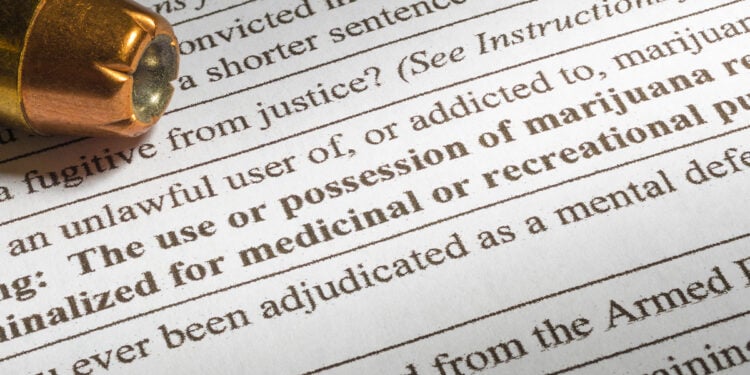
The brief also notes the inconsistency and vagueness of the law’s application, arguing that the federal standard makes it unclear who qualifies as an “unlawful user,” creating risks of arbitrary enforcement. It points out that even infrequent marijuana users must answer “yes” to the disqualifying question on ATF Form 4473 when attempting to purchase a firearm—an admission that could lead to denial of purchase or criminal prosecution.
In alignment with the Bruen decision, the brief urges the Court to evaluate the statute against the nation’s historical tradition of firearm regulation, which it argues does not support categorical bans on sober users of widely accepted substances.
As this case moves toward a final decision, it could have far-reaching implications for millions of Americans who lawfully use marijuana in accordance with their state laws. The Supreme Court’s ruling may clarify how far federal authority can go in restricting Second Amendment rights based on lifestyle choices that are no longer widely viewed as criminal.