

Key Takeaways
- The U.S. has sued Minnesota, Minneapolis, and St. Paul over a 30-day waiting period for handgun purchases.
- The lawsuit challenges provisions that require a wait for gun possession and a permit to purchase, affecting over 93% of Minnesotans.
- The complaint alleges police often exceed the 30-day deadline for permit processing with no penalties.
- The government seeks a declaratory judgment and a permanent injunction against enforcing the waiting period and permit provisions.
- Key legal arguments cite Second Amendment rights and past court cases questioning the constitutionality of similar regulations.
Estimated reading time: 5 minutes
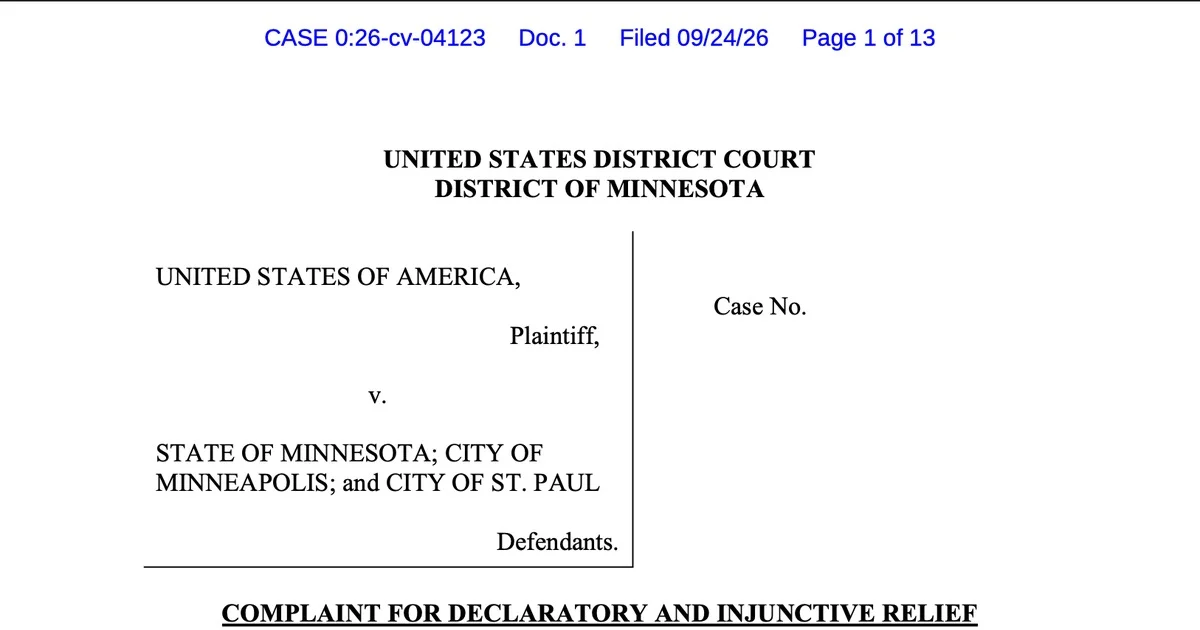
MINNEAPOLIS, MN — The United States has sued the State of Minnesota, the City of Minneapolis, and the City of St. Paul in federal court over the state’s 30-day waiting period and permit-to-purchase system for handguns and AR-15 style rifles. The 13-page complaint, captioned United States v. State of Minnesota, City of Minneapolis, and City of St. Paul, Case No. 0:26-cv-04123, was filed September 24 in the U.S. District Court for the District of Minnesota and is signed by Assistant Attorney General for Civil Rights Harmeet K. Dhillon.
Last week I covered the notice letter in DOJ Gives Minnesota Until Sept. 23 to Negotiate or Face a Federal Suit Over 30-Day Handgun Purchase Waits That Stretch to Nearly 60, which gave the state until 5:00 p.m. ET on September 23 to say whether it wanted to talk. That deadline came and went. The complaint hit the docket the next day. What was a three-page threat is now a filed case with a case number, three named defendants, and a specific list of what the government wants the court to order.
The complaint attacks two provisions that work together. Under Minn. Stat. § 624.7132 Subd. 4, a Minnesotan without a carry permit cannot take possession of a handgun or a regulated rifle until 30 days after a transferee report is delivered to the local chief of police or sheriff. The alternative is a permit to purchase under Minn. Stat. § 624.7131, which requires an application to the chief of police where the buyer lives, and the statute gives the chief up to 30 days to act on it. That permit is good for one year, so the complaint describes the result as an annual 30-day wait for anyone who simply wants a gun at home. Either path, the complaint says, means up to 30 days before a purchase.
Carry permit holders are exempt from all of this, and the complaint uses that exemption against the state. Citing Census figures and the BCA’s 2025 Permit to Carry report, it puts Minnesota’s population at 5,830,405 and its permit holders at 375,551. That means more than 93 percent of Minnesotans are subject to the wait. The complaint is explicit that this case is not about public carry at all. It is about a person who wants a handgun in the home, which the complaint, quoting Heller, calls the place where the need for self-defense is most acute.
Paragraph 20 is the factual core. The complaint alleges that approvals from the Minneapolis and St. Paul chiefs of police commonly exceed the 30-day statutory limit, and that some applicants have been forced to wait nearly 60 days. There is no statutory penalty for a department that misses the deadline and no remedy for the applicant when it happens. A deadline with no penalty and no remedy is a suggestion, and the complaint treats the resulting delays as the cities’ own conduct, not just the state’s.
The legal vehicle is 34 U.S.C. § 12601, part of the Violent Crime Control and Law Enforcement Act of 1994. That statute makes it unlawful for a governmental authority to engage in a “pattern or practice” of conduct by law enforcement officers that deprives people of constitutional rights, and it authorizes the Attorney General to sue for declaratory and injunctive relief to stop it. In plain terms, it is the same law the Justice Department has historically used to go after police departments for systemic misconduct. Here the alleged pattern is police doing exactly what state law tells them to do: processing permit-to-purchase applications and enforcing the 30-day wait. The complaint quotes Michigan v. DeFillippo for the proposition that police enforce laws until those laws are declared unconstitutional, and argues that when Minneapolis and St. Paul officers enforce these provisions, they act as agents of all three defendants.
On the Second Amendment merits, the complaint runs the test from Bruen as clarified this year in Wolford v. Lopez. Step one asks whether the law applies to the people, concerns arms, and restricts keeping or bearing them. If so, the law is presumptively unconstitutional and the burden shifts to the government to show a historical tradition of similar regulation. The complaint argues that acquiring a firearm is part of keeping one, citing Ezell from the Seventh Circuit, Nguyen v. Bonta from the Ninth, and Ortega v. Grisham from the Tenth, so step one is met. It then argues Minnesota cannot carry its burden at step two, pointing to Ortega, where the Tenth Circuit struck down a seven-day waiting period, and Nguyen, where the Ninth Circuit found a 30-day limit between purchases had no historical analogue.
More from USA Carry:
The government asks for two things. First, a declaratory judgment, meaning a court ruling that states the law: that the state and both cities are governmental authorities under Section 12601, that their officers are law enforcement officers under the statute, and that enforcing these provisions is a pattern or practice that deprives Minnesotans of their Second Amendment rights. Second, a permanent injunction under Rule 65, meaning a court order barring the defendants from enforcing the waiting period and permit-to-purchase provisions at all.
The complaint is signed by Dhillon, Deputy Assistant Attorney General R. Jonas Geissler, Second Amendment Section Chief Barry K. Arrington, and trial attorneys Mark K. Hellie, Keith W. Gaines, and Peter J. Abernathy, with U.S. Attorney Daniel N. Rosen and Civil Chief David W. Fuller for the District of Minnesota. I will continue tracking United States v. Minnesota, including any response from the state and the cities and any motion for a preliminary injunction.