

Key Takeaways
- The Justice Department’s opinion states that carrying a firearm into a post office for self-defense is permissible under certain conditions.
- Federal law, specifically 18 U.S.C. § 930, prohibits firearms in federal facilities but has exceptions for lawful carrying purposes.
- The opinion suggests that self-defense qualifies as a lawful purpose, countering previous narrow interpretations of the law.
- The Postal Service’s regulation against firearms lacks an exception for self-defense, making it potentially unenforceable for law-abiding citizens.
- This opinion is an internal legal interpretation and not a court ruling, meaning it does not bind the judiciary.
Estimated reading time: 6 minutes
WASHINGTON, DC — The Justice Department’s Office of Legal Counsel says the federal law that makes it a crime to bring a gun into a federal building does not apply to a law-abiding person who walks into a post office carrying for self-defense. The opinion, titled Application of 18 U.S.C. § 930(a) to Post Offices, is dated August 12, 2026. It is addressed to the Attorney General and signed by Principal Deputy Assistant Attorney General Lanora C. Pettit.
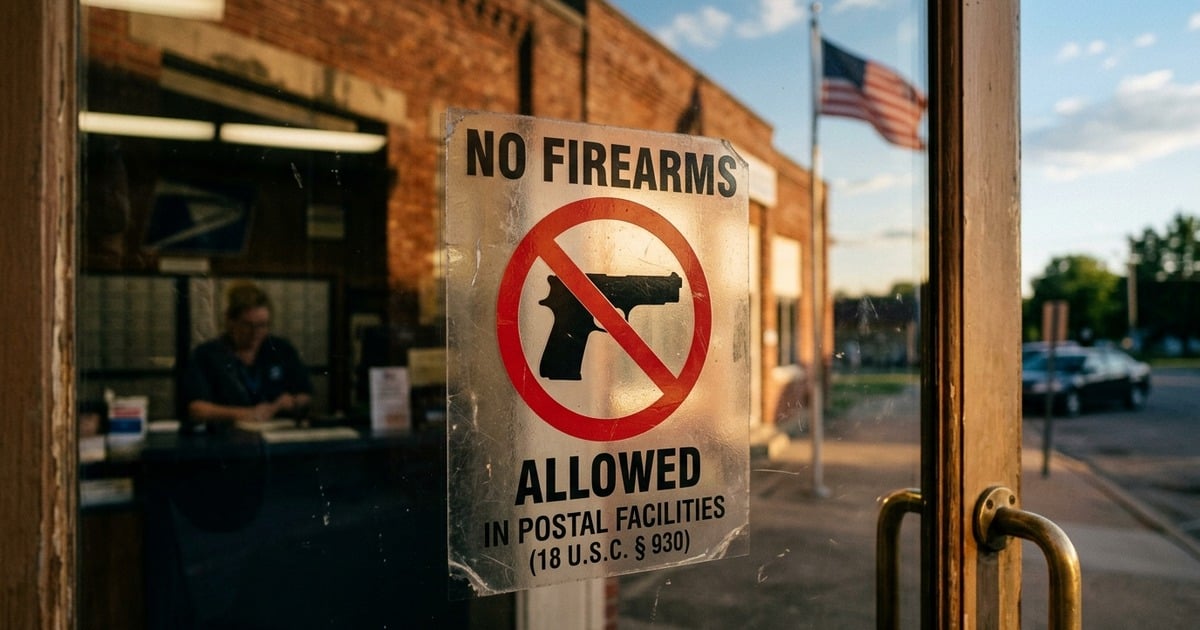
Here is the law in question. Under 18 U.S.C. § 930(a), knowingly bringing a firearm or other dangerous weapon into a federal facility can bring a fine, up to a year in prison, or both. A post office counts as a federal facility because the building is federally owned or leased and federal employees work there. The opinion puts the number at almost 31,000 retail post offices nationwide as of fiscal year 2025.
But the same statute carries exceptions. The one that matters to ordinary citizens is 18 U.S.C. § 930(d)(3), which says the ban does not apply to “the lawful carrying of firearms or other dangerous weapons in a Federal facility incident to hunting or other lawful purposes.”
The Department reads that exception as having two parts. The carrying has to be lawful, and it has to be for a lawful purpose.
On the first part, the opinion says the exception does not help anyone federal law already bars from having a gun. It lists convicted felons, people convicted of a misdemeanor crime of domestic violence, people who have been committed to a mental institution, and people in the country illegally. It also says the exception may not cover someone carrying without a license in a state that requires one. That is why your state’s carry licensing rules still decide whether any of this does you any good at the counter.
On the second part, the opinion says carrying for self-defense into a building open to the public is about as clear a lawful purpose as there is. It points to the Supreme Court’s statement in Heller that the inherent right of self-defense is central to the Second Amendment right.
That is a reversal for the Department. The opinion acknowledges that in past court filings, government lawyers argued the phrase “other lawful purpose” should be read narrowly, shaped by the one example the statute gives, which is hunting. The opinion also says it disagrees with district courts that read the exception to require the reason for carrying to be tied to the federal building itself, and it notes that at least one district court has landed the other way from the conclusion it reaches.
The Postal Service’s own rule gets handled separately. That rule, 39 C.F.R. § 232.1(l), bars anyone on postal property from carrying firearms, other dangerous or deadly weapons, or explosives, openly or concealed, except for official purposes. The opinion notes the rule has no self-defense exception written into it at all. Its conclusion is that the rule is unlawful as applied to law-abiding citizens carrying for self-defense in post offices open to the public, and that the Executive Branch may not enforce either the statute or the rule against such a person.
What stands out to me is the history the opinion walks through, because it is the argument armed citizens have been making for years. Congress in 1792 answered violence against the mail by making mail robbery punishable by death. It did not ban carrying inside a post office. No federal restriction on guns in post offices existed at all until the Executive Branch wrote one for federal buildings in 1964, then one for post offices specifically in 1972.
The opinion also names the disarm-at-the-door problem outright. Someone forced to leave a gun outside is left vulnerable for as long as he is unarmed, and he may be leaving a firearm where an aggressor, or a child, can find it. Anyone who has sat in a post office parking lot deciding what to do with a holstered pistol worked that out a long time ago.
Now the limits, because they matter as much as the conclusion.
First, this is a legal opinion from inside the executive branch. It is not a court ruling. It tells federal prosecutors how the Justice Department reads the law. It does not bind a judge.
Second, the opinion treats the statute and the postal rule differently, and that difference is deliberate. On the statute, the Department never says § 930(a) is unconstitutional, because it does not have to. Congress already wrote the “other lawful purposes” exception into the law, so the Department can simply read the statute to allow self-defense carry and stop there. Lawyers call that constitutional avoidance, which just means you decide the narrow question in front of you and leave the constitutional one alone. The postal rule offers no such off-ramp. There is no exception inside it to work with, so there is no way to read it narrowly, and that is why the Department goes further and says the rule cannot be enforced. It rests that on Congress passing a later and more specific law that narrowed the Postal Service’s authority over its own property, and, failing that, on the constitutional problems the opinion spells out.
More from USA Carry:
Third, the opinion draws its own borders. It does not address post offices closed to the public. It does not address other federal buildings. It does not cover weapons that are illegal to own in the first place. Federal courthouses fall under a separate part of the statute, 18 U.S.C. § 930(e), and nothing here touches them. And state law still decides whether your carry is lawful to begin with.
I will continue tracking how the Justice Department and the Postal Service put this into practice, and what happens the first time a court is asked to weigh in.